Context Matters: Anoki at Advertising Week New York 2026


Viewers don't watch genres. They watch moments. At Advertising Week New York 2026, Anoki and its partners brought the campaign results to prove it, and made a simple point: context matters.
Genre tells a buyer what a show is. It says nothing about what is happening on screen at any given moment. That gap ran through Anoki's week in New York, October 5–8, as its Context Matters campaign showed up on the Media Stage, at a demo station and on a truck rolling through the city.
The week also brought much of the CTV ecosystem into one place: advertisers, agencies, media owners and platforms. Across those conversations, one argument kept surfacing. When advertising understands what viewers are actually watching, scene by scene, it is more suitable for brands, more relevant for viewers and more valuable for everyone in between. The goal is a market where every ad meets the right moment on screen.
Panel recap: Beyond genre, on the Media Stage
“Beyond the Stream: Reimagining the CTV Advertising Experience”
Tuesday, October 6 · Media Stage
On Tuesday, October 6, Anoki and Amagi presented "Beyond the Stream: Reimagining the CTV Advertising Experience" on the Media Stage. Anoki Chief Commercial Officer Abbey Ramsey moderated a panel of Jana Hartz, VP Demand Partnerships at Amagi; David Nyurenberg, SVP, Digital at InterMedia Advertising; Kieran Geyer, Associate Director of Programmatic & Ad Tech Partnerships at Prudential Financial; and Alex Belaidi, VP, Data & Category Sales at Spectrum Reach.
The session centered on results, not roadmaps. Panelists shared what happened when campaigns went beyond genre to target the positive, uplifting storylines inside live content, a part of the schedule many buyers still exclude by default.
For InterMedia, the difference was plain in the data.
"Positive news stories outperformed negative news stories, with markedly better performance."
David Nyurenberg · SVP, Digital, InterMedia Advertising
Prudential Financial reported a similar pattern against its own baseline.
"Working with Anoki, we're performing above benchmark. A larger percentage of our impressions are converting relative to our CTV average."
Kieran Geyer · Associate Director of Programmatic & Ad Tech Partnerships, Prudential Financial
For Spectrum Reach, the takeaway was that context is not only a suitability tool. It moves outcomes.
"The work we did with Anoki, CarShield and InterMedia empirically proved that when you build more contextual intelligence into targeting, it's also a performance driver."
Alex Belaidi · VP, Data & Category Sales, Spectrum Reach
The proof: Smarter news targeting, stronger outcomes — results from an industry-first campaign for CarShield
During the panel, InterMedia Advertising debuted results from an industry-first campaign for CarShield, a high-volume direct-response TV advertiser selling vehicle protection plans. The question was whether the news most relevant to the brand could drive better lower-funnel results than the blunt exclusions many advertisers apply to live news.
The five-week controlled study ran on Spectrum Reach CTV across five equal-budget arms: relevant local news, relevant national news, less relevant local news, less relevant national news, and a run-of-network control with no Anoki filtering. Relevant meant positive and feature stories; less relevant meant negative and breaking coverage. Local news led the buy, since audiences see it as less polarized (Pew Research Center, Winter 2026).
Anoki ContextIQ for Live News made real-time subgenre, sentiment and suitability calls set to CarShield's brand rules. Activation ran through standard PMP deals via The Trade Desk and Magnite, with no custom integration.
At nearly equal spend and impressions, relevant news outperformed less relevant news:
- 57% more sales
- 28% more leads (145 vs. 113)
- 39% lower cost per sale
- 25% lower cost per lead ($291 vs. $391)
- Higher lead-to-sale rate (7.6% vs. 6.2%)
The result held over time and at the segment level. Relevant news led on cost per lead in 4 of 5 weeks, and its best weekly cost per lead, $191, came as efficiency improved over the flight. Relevant local news had the highest lead-to-sale rate of any arm, at 9.0%, and the cost-per-sale gap between the best and weakest segments was more than 2x.
The difference comes from how ContextIQ reads a broadcast. It analyzes speech, visuals and story progression in real time, so suitability follows how a story is told, not just what it mentions. A local newscast can move from a community food drive to a multi-car highway pileup in minutes, and the calls update in milliseconds as stories change.
The takeaway, in the case study's words: news isn't inventory to avoid. When the context is right, it's inventory that works harder. Access the case study.
Seeing is believing
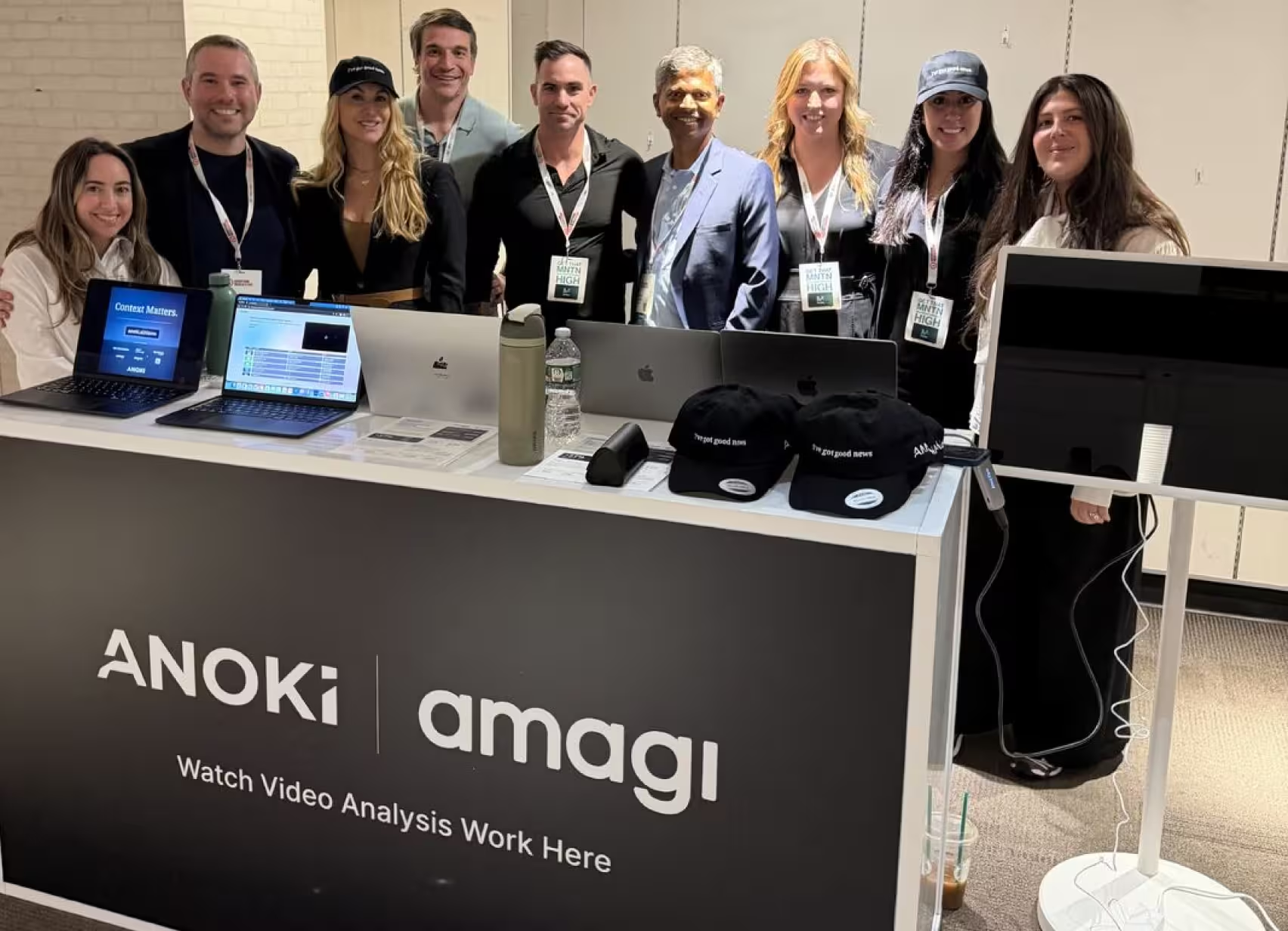
After the panel, the conversation moved to Anoki's demo station. Visitors saw Anoki ContextIQ for Live News in action, walked through the CarShield results, and tried a Live News activation built for Meta wearables.
The demo also showed how quickly the category has moved. ContextIQ for Live News debuted at IAB NewFronts in March 2026 with partners including Spectrum Reach. Six months later, the conversation in New York was about measured campaign outcomes rather than what the technology might do.
Context Matters, on wheels
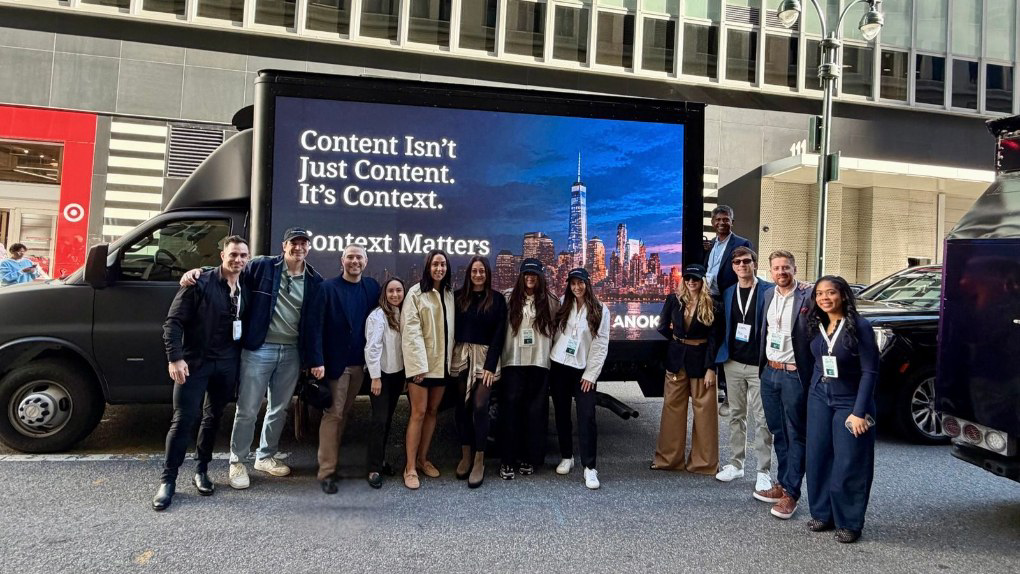
Outside the venues, the Context Matters campaign took to the streets on an Anoki ad truck that ran around New York throughout the week, including a stop in Times Square. Index Exchange, LG Ad Solutions, Amagi, Magnite and Spectrum Reach joined Anoki as truck partners.
The lineup reflects how many parts of the ecosystem it takes to put context to work in CTV, from publishers and platforms to the supply-side infrastructure that carries the signal.

Recognition this season
Advertising Week capped a season of industry recognition for Anoki and its partners:
- ContextIQ Copilot was named AI Marketing Copilot of the Year in the 2026 MarTech Breakthrough Awards.
- Anoki was recognized as a finalist for AI Innovator in the AdExchanger Awards.
- Anoki is part of Spectrum Reach’s AdExchanger Awards finalist entry for Best Use of Technology by a Publisher or Media Seller, “Spectrum Reach: Anoki’s ContextIQ for Live News Delivers Increased Sales for InterMedia.”
- “Spectrum Reach & Anoki AI: Good News Is Good for Business” was named a finalist for Best Monetization Platform for Publishers in the Digiday Technology Awards.
- Anoki joined Cohort 3 of Horizon Media’s HorizonOS Labs.
- Abbey Ramsey joined the AdTechGod Pod for Episode 152, “Turning What’s Happening on Screen Into an Ad Signal,” on real-time video intelligence, contextual targeting, and live news and sports.
Viewers watch moments — Anoki's 2026 CTV playbook
That idea is the core of Anoki's 2026 CTV playbook, which breaks down how scene-level context changes planning for news, sports and entertainment, with campaign results to back it up.
What you’ll take away
- Why genre labels misfire — and what it costs your reach
- How scene-level context works across sight, sound, and sentiment
- Brand safety vs. suitability, and how to set each
What stood out in New York was who made the case
It was not only a technology company describing its product. A publisher, an agency and a financial services brand stood on stage and shared their own numbers. Context matters, and the proof is now coming from the people buying and selling the media.
-